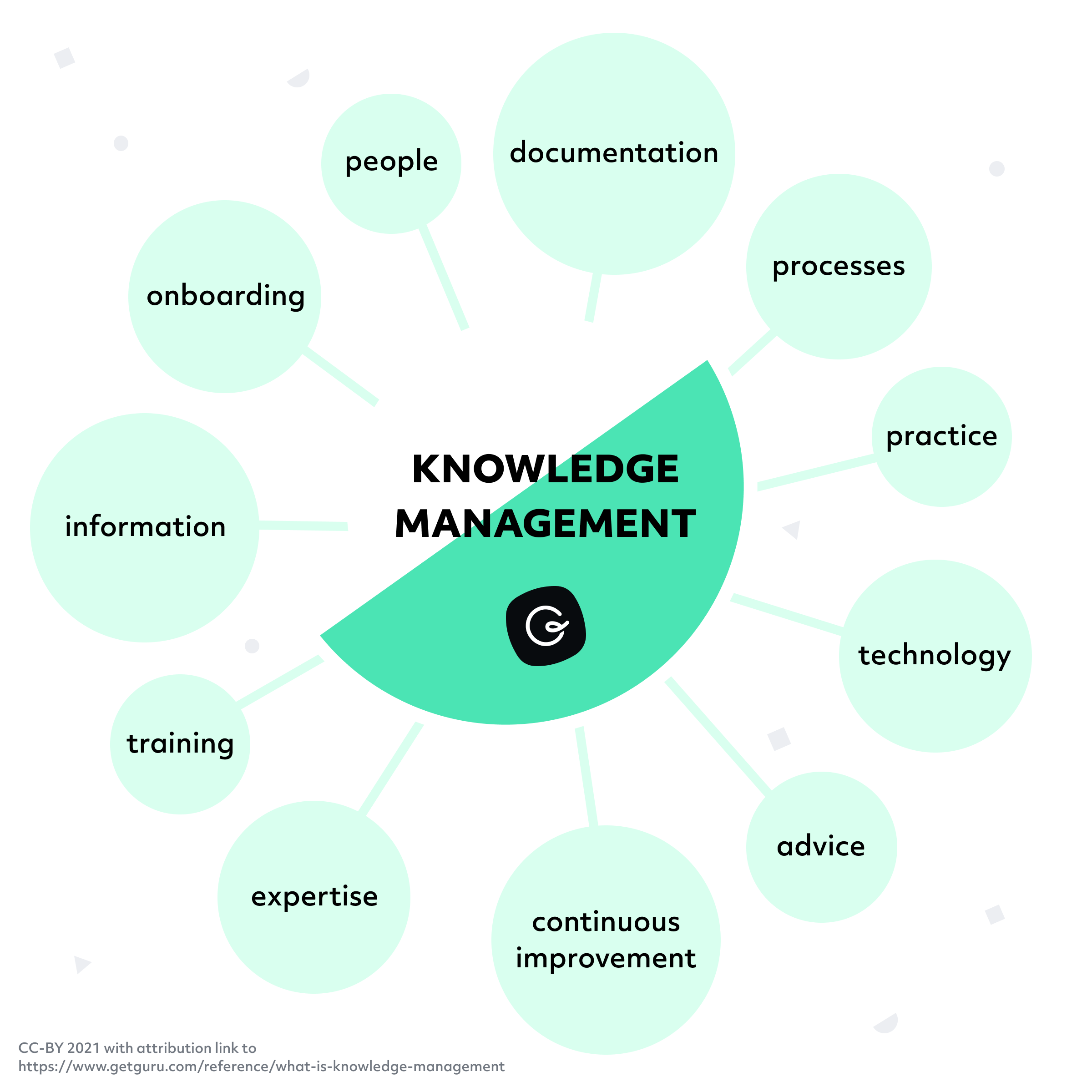
Knowledge management (KM) is the process of identifying, organising, storing and disseminating information within an organisation. When knowledge is not widely available inside an organization, it can be extremely costly to a company since valuable time is lost looking for relevant information rather than executing task-oriented duties. A knowledge management system (KMS) collects and organises an organisation's collective knowledge, resulting in increased operational efficiency. These systems are backed up by a knowledge base. They are typically crucial to good knowledge management because they provide a centralised location for storing and easily accessing information.
Businesses that implement a knowledge management strategy obtain better business outcomes faster, since improved organizational learning and collaboration among team members enables speedier decision-making across the firm. Additionally, it streamlines other organisational operations, such as training and onboarding, resulting in increased employee satisfaction and retention, according to surveys.
Today I want to talk to you about how you as a business in online education can benefit from suing KM and how to implement this to your company.
How to bridge that gap between knowledge management and eLearning?
Best practices in knowledge management show that KM and eLearning processes overlap:
Knowledge generation and acquisition: Your eLearning courses actively seek out trustworthy and current sources of knowledge and make them device-independent and accessible.
Organization and storage of knowledge: Your learning management system serves as a knowledge center, storing and categorizing your courses.
Distribution and integration of knowledge: Because all learners are enrolled in your course, you will be able to share and integrate this knowledge quickly and efficiently. When learners apply what they've learned in the workplace, they're integrating their prior knowledge with new information in order to gain the desired skill.
Knowledge adaption and application: Using newly acquired knowledge to foster a culture of innovative corporate practices.
Evaluation, validation, and refinement of knowledge: The widespread and successful use of your courses as determined by successful evaluation techniques. Courses are incrementally improved to meet the needs of both learners and organizations.
We simply demonstrated how knowledge management and eLearning complement one another. However, how can you ensure that knowledge is retained as a useful asset?
Knowledge can be implicit or explicit. Unspoken tacit information is difficult to capture. In your eLearning courses, explicit knowledge is freely shared.
According to research, the most effective strategy for measuring tacit or unseen knowledge is to establish a community of practice (COP) inside your learning environment.
Both can be combined using the following tools: Your e-learning platform
Nonaka and Takeuchi created the SECI Model for Knowledge Management about two decades ago (Socialisation, Externalisation, Combination and Internalisation).
When applied to a learning management system, this paradigm embodies knowledge management. Learning management systems have the potential to be effective resources for the development of COP.
This is how:
Socialisation: eLearning is fundamentally a social endeavor. Between learners and mentors, tacit information is readily exchanged. The purpose of knowledge management implementation is to organize discussions in chat rooms and forms around distinct themes. This enables both returning and new students to readily retain crucial information. Determine the knowledge gap and the associated need for knowledge.
Externalization: The process of transforming tacit knowledge into explicit knowledge via eLearning courses. As a course moderator, you should be aware of frequent issues and misunderstandings. Do they imply the necessity of a new course? Create a new course to address this need based on expert and learner conversations and resources. Assess the new themes that have been established for your organization.
Combination: Explicit knowledge in the repository is linked to other explicit knowledge. Update and amend your learning courses based on feedback from learners and experts. Assess newly produced courses for your organization.
Internalization: Knowledge taken from eLearning courses is converted to tacit knowledge in the form of skills and competences. Assess and evaluate employee learning via assessments.
The majority of learning management systems come packed with sufficient bells and whistles to transport you cross-country without stopping. What we are indicating is that learning management systems, in general, provide capabilities that can be used to reinforce knowledge management techniques while also serving as an eLearning hub within your organisations intranet.
All you needed was an insight, a "ulterior motive" for repurposing your learning management system as a potent tool for recombining information about knowledge and knowledge about information.
Anna Vorontsova
References
https://www.ibm.com/cloud/learn/knowledge-management
https://www.researchgate.net/publication/289759451_Adopting_Knowledge_Management_in_an_E-Learning_System_Insights_and_Views_of_KM_and_EL_Research_Scholars
https://www.talentlms.com/blog/knowledge-management-through-elearning/
https://www.researchgate.net/publication/2492849_Knowledge_Management_in_Online_Distance_Education
Keywords: knowledge management, elearning, education, online education, management information system, information analyses.


Great content about education!
ReplyDeleteVery informative blog about knowledge management, as very few people know about this it would.be right time for businesses to take advantage of it.
ReplyDelete